Omotesenke, Urasenke, and Mushakōjisenke: Understanding the Three Tea Schools
If you’ve started researching tea ceremony in Japan, you’ve likely encountered references to “Omotesenke,” “Urasenke,” or “Mushakōjisenke.” These are the three major schools (ryūha) of tea ceremony, all descended from the same legendary tea master. But what exactly are these schools, and do you need to understand their differences to enjoy a tea ceremony? The short answer: not really. The long answer: understanding the background enriches your appreciation, but all three schools share the same core philosophy and welcome sincere participants regardless of their knowledge.
The Common Ancestor: Sen no Rikyū
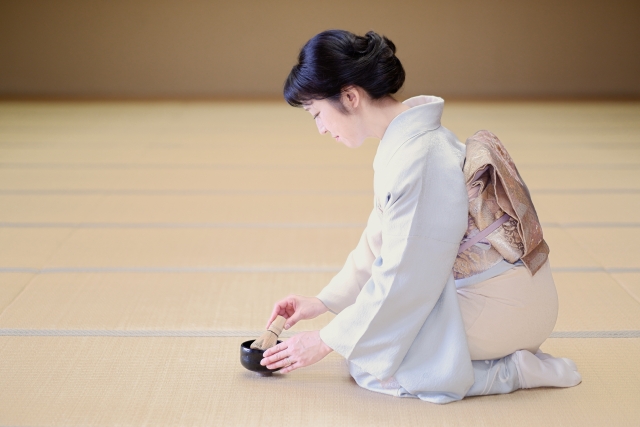
To understand the three Sen schools, we must start with Sen no Rikyū (1522-1591), the most influential figure in the history of Japanese tea ceremony. Rikyū refined tea ceremony from an aristocratic pastime into a spiritual practice emphasizing simplicity, humility, and mindfulness. His philosophy of wabi-cha (simple, rustic tea) transformed how tea was prepared, served, and experienced.
After Rikyū’s death, his grandson Sen no Sōtan (1578-1658) continued his legacy. Sōtan had four sons, three of whom established separate schools of tea ceremony, each building a tea house in Kyoto:
Kōshin Sōsa founded Omotesenke (表千家) – literally “front Sen house” Sensō Sōshitsu founded Urasenke (裏千家) – literally “rear Sen house”
Ichiō Sōshu founded Mushakōjisenke (武者小路千家) – named after the street location
These names come from the physical locations of their original tea houses in Kyoto’s Kamigyō ward, where they still stand today, just a few streets apart.
Core Tea Ceremony Similarities: What Unites the Schools
Before discussing differences, it’s crucial to understand that these three schools share far more than divides them:
- All trace their lineage directly to Sen no Rikyū
- All emphasize the same core principles: harmony (wa), respect (kei), purity (sei), and tranquility (jaku)
- All practice wabi-cha aesthetics
- All follow the same basic ceremony structure
- All welcome sincere students and guests
The differences are more like regional dialects of the same language rather than entirely different languages. Someone trained in one school can attend a ceremony held by another school and understand what’s happening, though they’ll notice stylistic variations.
Omotesenke: The Formal Tea Ceremony Approach
Characteristics:
Style: Often described as the most formal and traditional of the three schools. Movements tend to be precise and controlled.
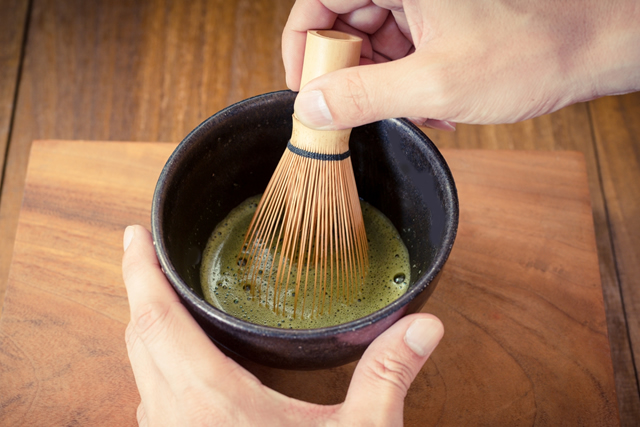
The foam: Omotesenke whisks matcha to create less foam than Urasenke, resulting in a thinner layer of bubbles on the surface.
The fukusa (silk cloth): Used in a specific folding pattern and handling technique that differs from the other schools.
Tea preparation: Emphasizes quiet elegance and restrained movements.
Modern presence: While highly respected, Omotesenke has fewer practitioners outside Japan compared to Urasenke. Within Japan, it maintains a strong, devoted following.
Where you might encounter it: Some traditional tea houses in Kyoto, particularly those with historical connections to the Omotesenke family residence.
Urasenke: The International Ambassador
Characteristics:
Style: Somewhat more relaxed and accessible than Omotesenke, while still maintaining formality and tradition.
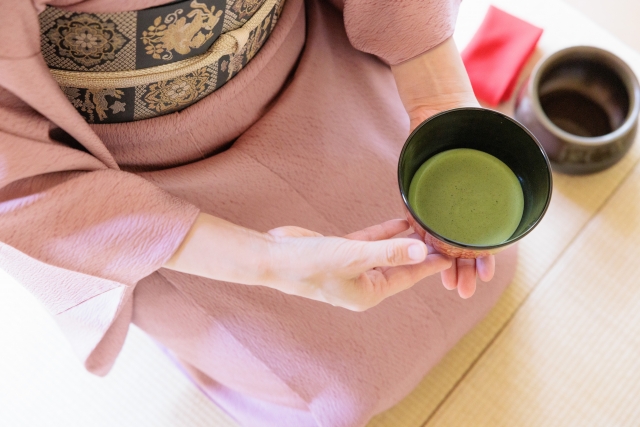
The foam: Urasenke whisks matcha vigorously to create a thick layer of foam covering the entire surface of the tea. This frothy appearance is what many people picture when they think of matcha.
Tea bowl rotation: The method of rotating the bowl (both when receiving and returning it) has slight variations from Omotesenke.
Global reach: Urasenke has been the most active in spreading tea ceremony internationally, establishing teaching centers worldwide. If you’ve encountered tea ceremony outside Japan, it was quite possibly Urasenke style.
Modern presence: The most widely practiced school both in Japan and internationally. Many tea houses catering to tourists use Urasenke procedures.
Where you might encounter it: Major hotels in Tokyo and Kyoto, cultural centers, many tea ceremony experiences designed for international visitors.
Mushakōjisenke: The Middle Path
Characteristics:
Style: Often described as occupying a middle ground between the formal precision of Omotesenke and the relative accessibility of Urasenke.
Smaller following: While equally legitimate and historically important, Mushakōjisenke has fewer practitioners than its two sibling schools.
Distinct procedures: Has its own specific variations in hand positions, folding methods, and ceremonial sequences.
Tea preparation: Creates moderate foam, between the minimal foam of Omotesenke and the abundant foam of Urasenke.
Modern presence: Less commonly encountered by tourists, though it maintains dedicated practitioners who value its particular approach.
Where you might encounter it: Specific tea houses affiliated with the school, some temples in Kyoto, private gatherings.
Practical Differences You Might Notice
As a guest at a tea ceremony, here are the differences you’re most likely to observe:
Visual cues:
The matcha foam: This is the easiest difference to spot. If your tea has abundant, thick foam covering the entire surface, it’s likely Urasenke. If there’s minimal foam with some liquid visible, it’s probably Omotesenke.
The fukusa color: Urasenke practitioners typically use vermillion (red-orange) fukusa, while Omotesenke uses a lighter orange. Mushakōjisenke practitioners may use different colors depending on rank.
Hand movements: The way the host folds and uses the fukusa differs between schools, though you’d need training to recognize these subtle distinctions.
Behavioral differences:
Formality level: You might find Omotesenke ceremonies feel slightly more formal and austere, while Urasenke might feel marginally more welcoming to beginners.
Teaching approach: Urasenke’s international focus means their instructors often have more experience explaining concepts to non-Japanese speakers.
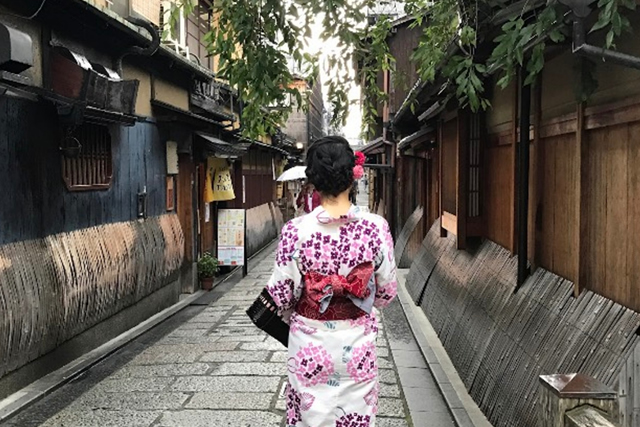
Does It Matter Which Tea Ceremony School You Experience?
For most travelers and beginners, honestly, no—it doesn’t matter much which school you encounter. Here’s why:
The essence is the same: All three schools teach mindfulness, respect, and appreciation of simplicity. The spiritual and aesthetic goals are identical.
You won’t be tested: No host expects you to know which school they represent or to adjust your behavior accordingly. Your sincere participation matters far more than technical knowledge.
Differences are subtle: Unless you’ve studied tea ceremony extensively, you might not even notice the variations. You’ll be too engaged in the experience itself.
Flexibility exists: Many tea houses, especially those serving tourists, incorporate elements that make the experience accessible regardless of strict school affiliation.
That said, understanding that these schools exist and have slightly different approaches adds depth to your appreciation. When you notice the thick foam in your Urasenke ceremony or observe the precise movements of an Omotesenke host, you’re seeing centuries of refinement passed down through generations.
Learning Tea Ceremony Basics at Tea Ceremony Canon Kyoto
For international visitors interested in experiencing tea ceremony, Tea Ceremony Canon Kyoto takes an approach particularly suited to beginners: teaching the fundamental principles that unite all schools of tea ceremony.
Located just one minute’s walk from Fushimi Inari Shrine, Canon Kyoto focuses on introducing foreign travelers to the core concepts that Sen no Rikyū established—the principles of harmony, respect, purity, and tranquility that all three Sen schools share. This foundational approach means you’ll learn the essential movements, proper etiquette, and underlying philosophy without getting overwhelmed by school-specific variations.
The instructors can explain the existence of different schools and point out which stylistic elements belong to which tradition, giving you context without requiring you to master distinctions that take Japanese practitioners years to fully understand. This educational approach serves travelers well: you’ll leave with a solid grasp of tea ceremony fundamentals and an awareness of the rich tradition’s complexity without feeling lost in technical details.
What makes this particularly valuable is the English-language instruction. The guides understand which aspects of tea ceremony are most important for first-time participants to understand and which details, while fascinating to experts, might confuse or overwhelm beginners. They can answer your questions about the different schools while keeping the focus on your hands-on experience.
Combined with the kimono rental service and the proximity to Fushimi Inari, your tea ceremony experience becomes an integrated cultural immersion. Whether the ceremony you participate in follows more closely to one school or another, you’ll understand you’re connecting to a living tradition that has been passed down through generations of the Sen family.
Respecting All Traditions
It’s important to note that discussions of the three schools should never suggest one is “better” than another. Each represents a legitimate continuation of Sen no Rikyū’s teachings, refined through centuries of practice. Within Japan, practitioners of each school maintain deep respect for the other schools, recognizing their common heritage and shared values.
Occasionally you’ll hear practitioners express preferences or gentle rivalry—much like siblings might—but this is typically good-natured. The tea ceremony world generally emphasizes what unites practitioners rather than what divides them.
How to Identify the School
If you’re curious which school a particular tea ceremony follows:
Look for posted information: Many tea houses display their school affiliation at the entrance or in informational materials.
Ask your host: It’s perfectly appropriate to politely inquire, “Which school of tea ceremony does this follow?” Hosts are usually happy to explain.
Observe the foam: While not definitive, the amount of foam on your matcha is often the easiest clue for beginners.
Check their website: If booking in advance, tea houses typically mention their school affiliation.
Notice the family name: If your host’s surname is Sen (千), there’s a chance they’re directly connected to one of the schools, though many practitioners from other families also teach within these traditions.
Beyond the Three: Other Schools Exist
While Omotesenke, Urasenke, and Mushakōjisenke are the most prominent and numerous, other schools of tea ceremony also exist in Japan:
- Enshū-ryū (遠州流)
- Sekishū-ryū (石州流)
- Yabunouchi-ryū (藪内流)
- And several others
These schools developed their own traditions, often influenced by regional customs or particular historical figures. However, you’re far less likely to encounter them as a tourist unless you specifically seek them out.
What Matters Most
At the end of the day, the school matters less than your presence and sincerity. Whether you’re participating in an Omotesenke ceremony with minimal foam, an Urasenke ceremony with abundant froth, or a Mushakōjisenke ceremony somewhere in between, the essential experience remains the same:
- The warmth of the bowl in your hands
- The bitter-sweet taste of matcha
- The quiet focus of the present moment
- The connection with others sharing this experience
- The centuries of tradition flowing through each gesture
The differences between schools are fascinating to those who study deeply, but they need not concern you as a beginner. Approach each tea ceremony with openness, respect, and curiosity, and you’ll honor the tradition regardless of which school’s procedures are being followed.
Three houses, one teaching. Three paths, one destination. The tea is whisked, the bowl is passed, and in that moment, school distinctions fade into the simple beauty of shared presence.
Canon Kyoto Tea Ceremony Booking
Please Select Your Booking Option:
🇺🇸 English Booking Form
If you’re comfortable proceeding in English,
you can complete your reservation using the booking form below.
🌐 Multilingual Booking Page
If you’d prefer to view the booking page in your native language,
please click here to access our Multilingual Booking Form.


